
In the ever-evolving landscape of construction and design, staying informed on industry standards is imperative. The latest update to the tile product standards ANSI A137.1, A137.2, and A137.3 include the new ANSI A326.3 product use categories. These categories, centered around slip resistance characteristics, provide manufacturers with a way to communicate designated areas of use.
We’ve summarized below what you need to know about the updated standard and how International Product Assurance Laboratories can help ensure compliance for your product.
The New Product Use Categories
Manufacturers are now required to classify their products into one or more of the following categories:
- Interior, Dry (ID)
- Interior, Wet (IW)
- Interior, Wet Plus (IW+)
- Exterior, Wet (EW)
- Oils and Greases (O/G)
For detailed guidance on these categories, the Tile Council of North America offers a complimentary digital copy of the standard.
Testing Methods to Help You Determine Classifications
International Product Assurance Laboratories provides various test methods to assist manufacturers in determining product use classifications.
1. ANSI A326.3 (DCOF):
The video above shows the ANSI A326.3 Dynamic Coefficient of Friction (DCOF) test in action.
Key details of this test:
- Utilizes an automated drag sled-type tribometer
- Our laboratory uses the BOT 3000E as shown in the test video
- The test requires:
-An SBR test foot
-A 0.05% Sodium-Lauryl Sulfate (SLS) solution to measure the wet DCOF value in four test directions - Dry DCOF values can also be measured upon request
- ANSI A326.3 DCOF test can be performed within both laboratory and field settings.
2. DIN/EN 16165 Annex C and ASTM E303 (British Pendulum):
The British Pendulum test involves a pendulum friction tester, measuring the loss of energy as a rubber test foot slides across the test specimen’s surface.
How the test works:
- Typically conducted in wet conditions using potable water
- It can also be conducted to provide a dry value upon request
With the ability to be conducted in both laboratory and field environments, the test results are expressed as Pendulum Test Values (PTVs) or British Pendulum Numbers (BPNs).
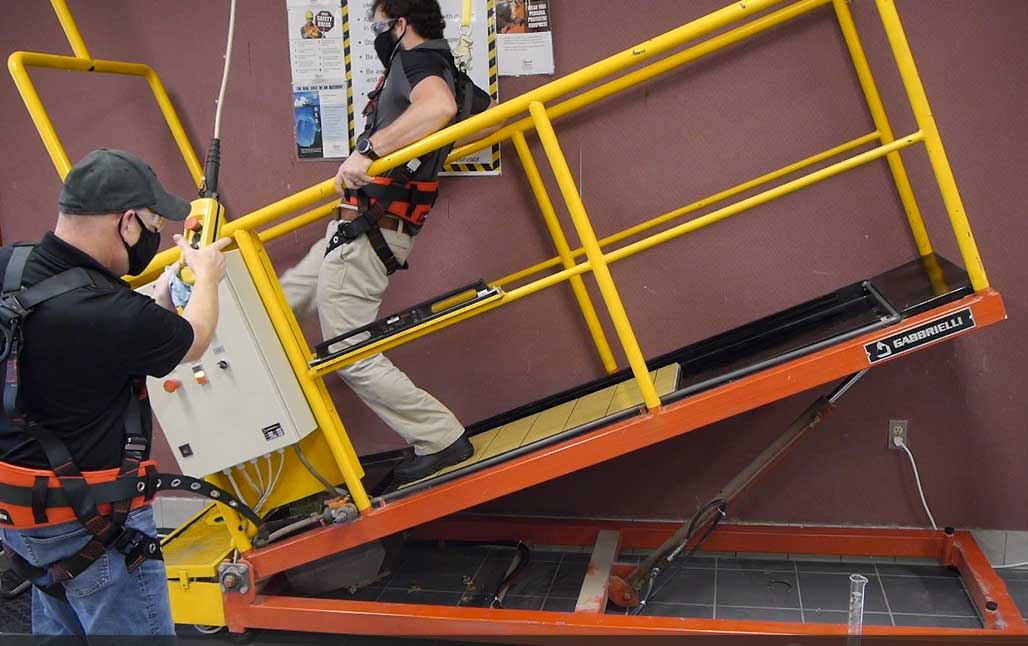
3. DIN/EN 16165 Annex B (German Ramp):
As shown in the video, the German Ramp test:
- Requires two technicians
-One controls the incline
-The other walks on the ramp in standardized work shoes - This test determines the angle at which a slip occurs
- The mean angle, obtained from multiple operator tests, is expressed as an “R” value, offering a precise degree of slip resistance
This method is exclusively suitable for laboratory use.
Pro tip: Watch the full German Ramp test method.
Ensuring Compliance for You
Manufacturers, armed with the results from these tests, internal quality control criteria, manufacturing parameters, and experience with similar surfaces can confidently determine the product use category for their products.
Contact International Product Assurance Laboratories at testing@ipalaboratories.com or call (864)-646-8453 to order testing that will assist you in determining product use categories.
