

In November 2025, ANSI A128.1 was introduced as a new test method for evaluating the dimensional stability of agglomerate tile, natural stone tile, and non-ceramic manufactured specialty tiles when exposed to moisture. In this context, dimensional stability refers to a material’s ability to maintain its original shape and size when subjected to moisture. Some tile materials are sensitive to water and may deform, meaning they can warp, curl, or change shape, often with corners lifting up or down, or uneven movement across the surface.
This standard fills a long-standing gap in U.S. installation guidance by providing a reliable way to determine whether tiles may deform after exposure to water-based mortars, adhesives, substrates, or maintenance conditions and what that means for installation decisions. Dimensionally stable products are less prone to this type of movement, while more sensitive materials may require specific installation approaches to prevent issues.
For manufacturers, designers, installers, and specifiers, ANSI A128.1 creates a clearer connection between measured deformation behavior and appropriate installation methods.
Why ANSI A128.1 Was Needed
Before ANSI A128.1, dimensional stability was commonly evaluated using EN 14617-12, a European method with notable limitations. Using this method, testing exposure lasted only six hours and required samples that were cut to 12 × 12 inches, conditions that often did not reflect real installation environments in North America.
In practice, deformation-related installation problems frequently develop days or even weeks after installation and are more likely to occur in larger tile formats. Moisture from adhesives and substrates can also influence performance in ways that short-duration testing cannot capture.
ANSI A128.1 was developed to better represent these real-world conditions and provide more meaningful installation guidance.
What ANSI A128.1 Measures
ANSI A128.1 evaluates how tiles respond to moisture exposure from mortars, adhesives, substrates, and maintenance conditions. Unlike earlier approaches, the standard includes two complementary testing methods, allowing users to evaluate either the tile alone or the full installation assembly.
Method A: Tile-Only Evaluation
This method measures deformation of the tile itself when exposed to moisture, providing a baseline understanding of whether the material is inherently stable or sensitive to water-based setting systems.
Method B: Installation Assembly Evaluation
This method evaluates deformation within an installation assembly, verifying how a tile performs when used with specific mortars, adhesives, membranes, or substrates. This method is especially valuable when confirming whether a proposed installation technique is appropriate for a moisture-sensitive material.
Together, these methods make ANSI A128.1 both a material characterization tool and an installation verification tool. The standard is particularly useful for large-format materials, resin-backed products, agglomerates, moisture-sensitive stone, and specialty non-ceramic tiles.
Tile Classifications and Installation Guidance
One of the most practical features of ANSI A128.1 is its stability classification table and informative annex on mortar/adhesive recommendations which help determine whether standard cementitious mortars are appropriate or if alternative installation materials should be considered:
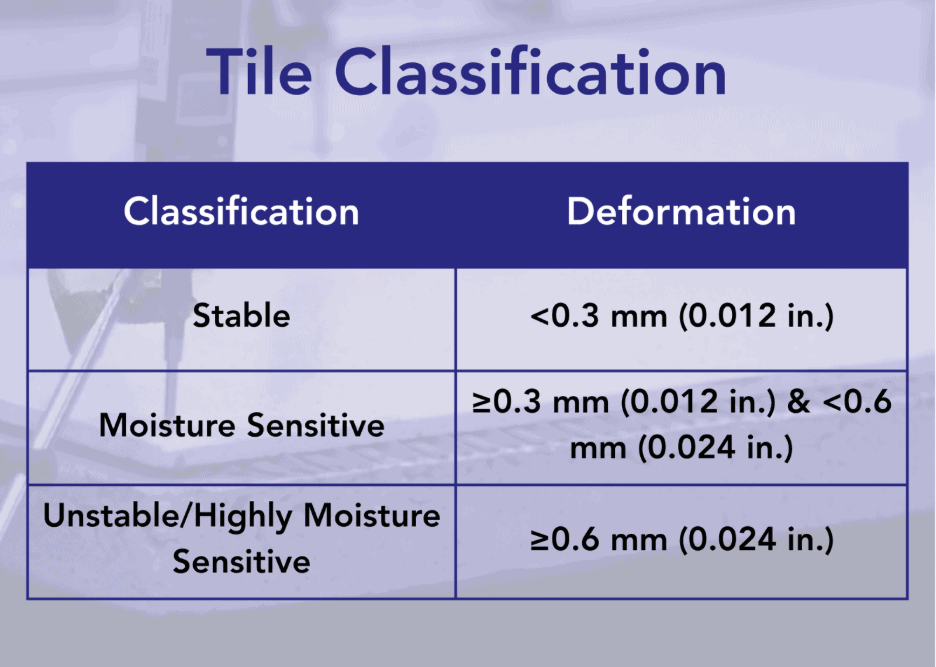
Tiles classified as stable are less likely to experience excessive deformation when installed with water-based adhesives over porous substrates provided manufacturer recommendations are followed. Typical mortars used with stable tiles include ANSI A118.1, A118.4, A118.15, A136.1, and A118.3.
Tiles identified as moisture sensitive may benefit from fast-setting mortars or epoxy adhesives. In these cases, additional assembly testing using Method B can help confirm whether a proposed installation system will perform as intended. Mortars such as ANSI A118.4F, A118.15F, and A118.3 are commonly considered.
Tiles classified as unstable or highly moisture sensitive often require ANSI A118.3 epoxy adhesives for adhered applications. Additional assembly-specific testing is recommended before finalizing installation methods.
Real-World Impact: Preventing Installation Failures
The value of ANSI A128.1 is already evident in practice.
In one recent project involving significant post-installation deformation, the tile material was later evaluated using ANSI A128.1 and classified as unstable. Based on that classification, the original installation method likely would not have been recommended.
Earlier testing could have led to a different adhesive selection and possibly prevented the installation failure altogether.
This example highlights how ANSI A128.1 supports better decision-making before installation begins, rather than serving only as a diagnostic tool after problems occur.
Why This Standard Matters for the Tile Industry
ANSI A128.1 helps bridge the gap between material properties and installation performance by providing a structured way to evaluate moisture-related deformation.
Manufacturers can better characterize their products. Architects and designers gain confidence when specifying materials. Installers benefit from clearer guidance when selecting adhesives and installation systems.
Most importantly, testing results help reduce the likelihood of deformation in an installation caused by moisture-related instability issues.
Moving Forward with ANSI A128.1
As the industry continues to navigate larger tile formats, evolving materials, and more complex assemblies, understanding how materials respond to moisture exposure is increasingly important.
ANSI A128.1 provides a practical framework for evaluating deformation, selecting appropriate setting materials, and verifying installation techniques before work begins.
By aligning laboratory evaluation with real-world installation behavior, the standard helps ensure performance expectations match field conditions not just short-duration test results.
IPA Labs provides ANSI A128.1 testing to help manufacturers, specifiers, and installers better understand moisture-related deformation and evaluate appropriate installation methods. Learn more about our agglomerate tile testing lab services.
