
Laboratory test reports contain a lot of numbers. But understanding what those numbers actually tell you about a product, and just as importantly, what they don't, is essential to interpreting test results.
In our By the Test Method series, we're taking a closer look at some of the most commonly used laboratory tests for ceramic tile and related products. We'll explain what each test measures, how the testing is performed, and how the results are used to evaluate and classify products.
We're starting with one of the most fundamental properties of ceramic tile: water absorption.
What Is Water Absorption?
Water absorption is a measure of the amount of water that can enter the accessible pores of a ceramic tile body. It is expressed as a percentage of the tile's dry mass.
In general, a more porous tile body absorbs more water, while a denser body absorbs less. This relationship makes water absorption an important characteristic for classifying ceramic tile, including distinguishing porcelain tile from other ceramic tile products.
While the concept is relatively simple, obtaining a meaningful and consistent result requires a standardized test procedure.
How Is Water Absorption Tested?
In the United States, water absorption of ceramic tile is commonly determined using ASTM C373, Standard Test Methods for Determination of Water Absorption and Associated Properties by Vacuum Method for Pressed Ceramic Tiles and Glass Tiles and Boil Method for Extruded Ceramic Tiles and Non-tile Fired Ceramic Whiteware Products.
At a high level, the process involves four basic steps:
Dry. Weigh. Saturate. Weigh again.
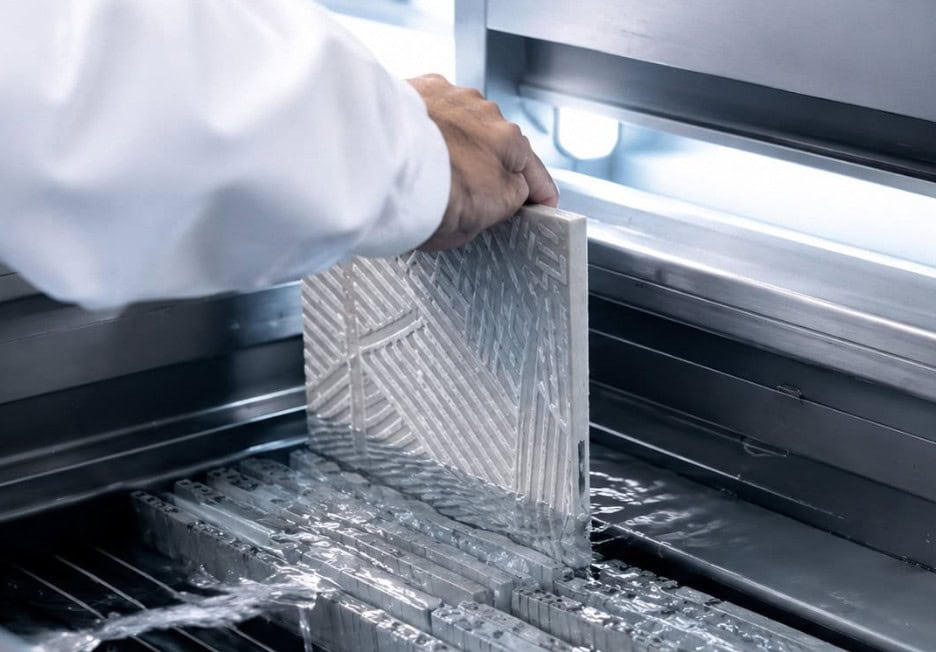
First, specimens are dried to remove moisture, and their dry mass is recorded. The specimens are then saturated with water according to the standard testing procedure. After saturation, the specimens are weighed again.
The difference between the dry and saturated masses is used to calculate the percentage of water absorbed by the specimen.
Although the calculation itself is straightforward, details such as specimen preparation, drying, saturation, and weighing procedures are critical to obtaining reliable results. Following a standardized method helps ensure results can be consistently evaluated and compared.
Why Does Water Absorption Matter?
Water absorption is an important physical property of ceramic tile, influencing how products are classified and helping inform decisions about their intended applications. One of the most familiar classifications is porcelain tile.
Under ANSI A137.1, porcelain tile is defined as ceramic tile that has a water absorption of 0.5% or less when tested in accordance with ASTM C373.
This classification is particularly relevant when evaluating tile for applications where moisture exposure is a consideration. However, water absorption is just one factor in determining whether a product is appropriate for a particular installation.
That means the term porcelain isn't simply a description of how a tile looks, how thick it is, or how it was manufactured. It is tied to a measurable physical property determined through laboratory testing.
What Does a Water Absorption Result Tell You?
A water absorption test provides a specific piece of information: how much water the tested specimens absorb under the conditions of the test method.
That result can be used to classify the product and determine whether it meets a specified water absorption requirement, including the criteria for porcelain tile classification. However, it is equally important to understand what the result doesn't tell you.
A low water absorption result does not, by itself, demonstrate that a tile meets every performance requirement associated with its intended application.
Water absorption testing does not determine characteristics such as:
- Breaking strength
- Abrasion resistance
- Slip resistance
- Chemical resistance
- Stain resistance
- Dimensional characteristics
Each of these properties requires its own test method.
This distinction is important when reviewing laboratory reports or evaluating product claims. A test result should always be considered in the context of what was tested, which method was used, and what requirement or product characteristic is being evaluated.
From a Test Result to Porcelain Certification
A laboratory can test ceramic tile and determine whether the specimens have a water absorption of 0.5% or less. But a single laboratory test and an independent product certification program serve different purposes.
That's where the Porcelain Tile Certification Agency (PTCA) comes in.
PTCA provides independent certification that qualifying ceramic tile products meet the water absorption criteria for porcelain tile. Products are tested by approved laboratories using ASTM C373, and continued participation includes periodic retesting to help ensure certified products continue to meet program requirements.
For manufacturers, certification provides independent verification of a product's porcelain classification. For distributors, specifiers, designers, and other industry professionals, it provides a way to verify whether products represented as porcelain have been independently evaluated.
With the launch of PTCA's new website and searchable product database, identifying and verifying PTCA Certified Porcelain products will be easier than ever.
One Test, One Piece of the Performance Picture
Water absorption is one of many properties used to evaluate ceramic tile. Understanding what individual test results reveal, and how those results work together, provides a more complete picture of a product's performance and suitability for different applications.
In future installments of By the Test Method, we'll take a closer look at other important characteristics, including breaking strength, abrasion resistance, slip resistance, and how they are evaluated through standardized testing.
Have a test method you'd like us to cover? Let us know.
