
Understanding XRF, Lead Quick Checks, and ASTM Leachability Testing
Seeing a lead test performed on ceramic tile, dishes, or another glazed product can be alarming, especially when a handheld device displays a high number or a chemical test produces a dramatic color change. But a positive screening result does not, by itself, mean that a ceramic product is unsafe or that a hazardous amount of lead is available at the surface.
Videos and posts showing people testing ceramic tile, dishes, and other glazed products for lead have become increasingly common on social media. A handheld XRF analyzer may display a lead concentration, or a chemical test may produce a dramatic color change. These results are sometimes presented as evidence that a ceramic product is unsafe or that lead is readily available at the surface.
The science is more complicated.
Finding lead in a ceramic product is not the same as demonstrating that lead is leaching from the product. Handheld XRF, chemical quick-check kits, total lead analysis, and standardized leachability testing answer different analytical questions. Treating the results as interchangeable can lead to misleading conclusions.
What Social Media Lead Tests May Be Missing
A common misconception is that any detection of lead in a ceramic tile or glaze means that someone touching or using the product is being exposed to the amount reported by the test.
That conclusion cannot be made from an XRF measurement alone.
X-ray fluorescence (XRF) is a nondestructive analytical technique used to identify and estimate the concentration of elements, such as lead, in a material. The instrument directs X-rays at the sample, causing elements within the material to emit characteristic X-rays that can be measured and used to identify the elements present.
On a glazed ceramic product, that measurement may include contributions from the glaze, pigments, decorations, underlying layers, ceramic body, or material deposited on the surface, such as dust or other contamination. As a result, detection of lead by XRF alone does not necessarily establish where the lead is located or whether it is part of the original ceramic product. It does not directly measure the amount of lead that can migrate, dissolve, or leach from the surface.
This distinction is recognized even in federal testing guidance. The U.S. Consumer Product Safety Commission (CPSC) permits certain XRF technologies for some homogeneous materials under defined conditions, but its XRF procedure for homogeneous siliceous materials (materials such as glass or unglazed ceramics that are relatively uniform in composition throughout the portion being analyzed) specifically states that the approach is not suitable for glazed ceramics. CPSC also requires consideration of measurement uncertainty and multiple measurements when XRF is used in applications for which the method is appropriate. (U.S. Consumer Product Safety Commission)
Another potentially confusing comparison involves the federal lead-in-paint limit. Ceramic glazing does not meet CPSC’s definition of paint or a similar surface coating and therefore is not subject to the CPSC requirement (16 CFR Part 1303) simply because it is a coating-like material on the surface of a ceramic product. (U.S. Consumer Product Safety Commission)
This does not mean that the presence of lead should be ignored. It means the result must be interpreted in the context of what was measured, how it was measured, and what question the test is capable of answering.
A Number on an XRF Screen Is Not a Leachability Result
Consider a hypothetical social-media demonstration in which an XRF analyzer reports several hundred or several thousand parts per million of lead on a glazed tile.
That measurement may be useful evidence that lead is present within the XRF measurement volume. But it does not mean that the reported concentration is sitting freely on the surface, nor does it tell us how much lead would be released from the glaze.
Those are separate analytical questions.
This is particularly important with ceramics because firing creates a complex glassy glaze matrix. Lead detected as part of that material cannot automatically be equated with lead that is extractable from its surface.
If the concern is leachability, the product needs to be evaluated using a method designed to measure leachability.
Quick-Check Kits Have Similar Limitations
Chemical swabs and other inexpensive lead quick-check products can make especially compelling social-media content because a visible color change appears to provide a simple yes-or-no answer.
Unfortunately, analytical chemistry is rarely that simple.
CPSC has evaluated consumer lead test kits and documented both false-positive and false-negative results. Interferences from other substances and even the color of the material being tested can affect interpretation. CPSC cautions against relying on these kits to assess lead in consumer products and emphasizes laboratory testing when accurate assessment is required. (U.S. Consumer Product Safety Commission)
More recent independent testing has similarly found that consumer lead-test kits become considerably less dependable as lead concentrations decrease. (Consumer Reports)
A chemical reaction on a ceramic surface therefore should not automatically be interpreted as proof that a tile or ceramicware contains a particular concentration of lead—or that a hazardous quantity of lead is leaching from the material.
Detection, Total Content, and Leachability Are Different Measurements
This distinction is critical when interpreting information shared online.
| Type of Test | What It Can Tell You | What It Does Not Establish |
|---|---|---|
| Handheld XRF | Whether lead may be present within the material being measured and, under appropriate conditions, elemental concentration | How much lead will leach from the surface |
| Lead Quick-Check/Swab | Qualitative screening response | Reliable quantitative lead concentration or standardized leachability |
| Laboratory Total Lead Analysis | Quantitative lead content of the material analyzed | How much lead will migrate from the finished surface |
| ASTM C738/C895 | Lead and cadmium extracted from a glazed surface under defined conditions | Total lead content of the entire project |
A result from one column cannot simply be converted into the answer provided by another test.
If Leachability Is the Question, Test Leachability
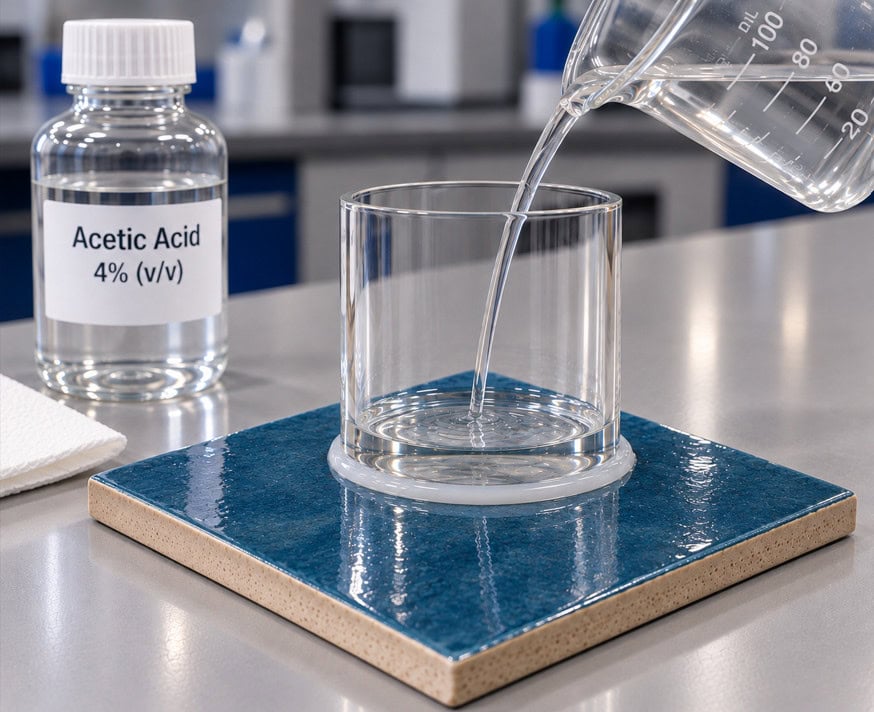
For glazed ceramic products, standardized laboratory methods are available to evaluate the amount of lead that can actually be extracted from the surface.
ASTM C895, Standard Test Method for Lead and Cadmium Extracted from Glazed Ceramic Tile, specifically addresses glazed ceramic tile intended for use in food-preparation areas, such as countertop tile. The method uses an acetic-acid extraction designed to accelerate release from the glaze, followed by quantitative measurement of the extracted lead and cadmium. ASTM describes the extraction as a severe test unlikely to be matched under actual conditions of use. (ASTM Store)
ASTM C738, Standard Test Method for Lead and Cadmium Extracted from Glazed Ceramic Surfaces, similarly provides a standardized procedure for determining lead and cadmium extracted by acetic acid from glazed ceramic surfaces. (ASTM Store)
These tests answer a fundamentally different question from XRF:
XRF asks: Is lead present in the material being measured?
Leachability testing asks: How much lead is extracted from the glazed surface under specified test conditions?
For questions about potential release from a ceramic surface, that distinction matters.
XRF Is Still a Valuable Tool
None of this means XRF is a poor analytical technology.
Quite the opposite. Laboratory XRF is an extremely valuable technique for materials characterization, elemental screening, comparison of glaze formulations, identification of compositional differences, and investigation of manufacturing or product issues.
The concern is interpretation.
A screening tool becomes misleading when its result is presented as answering a question the analytical method does not actually measure.
A handheld XRF reading can provide useful information about elemental composition. It should not, by itself, be presented as proof of lead leachability or as a direct measure of human exposure.
Likewise, a chemical quick-check may indicate that further investigation is warranted, but it should not be treated as a substitute for quantitative laboratory analysis.
Look Beyond the Social Media Result
When you see a video claiming that a ceramic tile or glazed ceramic product contains a concerning amount of lead, consider asking a few additional questions:
What test was actually performed? Was the method validated for glazed ceramic materials? Is the reported number total lead, an XRF measurement, or extractable lead? Most importantly, was leachability actually measured?
Without those answers, a dramatic reading or color change provides only part of the story.
The presence of lead, the concentration of lead within a material, and the amount of lead that can be extracted from its surface are related—but analytically distinct—questions.
The Bottom Line
Social-media lead testing can bring useful attention to product composition, but a screening result should not be interpreted beyond the capabilities of the test method.
Detecting lead in or on ceramic tile does not, by itself, demonstrate lead leachability or establish the amount of lead that could be released from the surface.
When leachability is the concern, the appropriate approach is to use a standardized extraction method specifically designed to answer that question.
Need Laboratory Testing?
Rather than relying solely on a handheld XRF reading or chemical quick-check, laboratory leachability testing can provide quantitative results using standardized test conditions. IPA Laboratories can help determine which test method is appropriate based on the product type and the specific question being evaluated.
IPA Laboratories offers ASTM C895 and ASTM C738 testing for the leachability of lead and cadmium from applicable glazed ceramic products as well as XRF analysis of total lead content in bulk ceramic materials.
Before drawing conclusions from a lead screening result, make sure the test being used actually answers the question being asked. Request testing by submitting a request form.
