
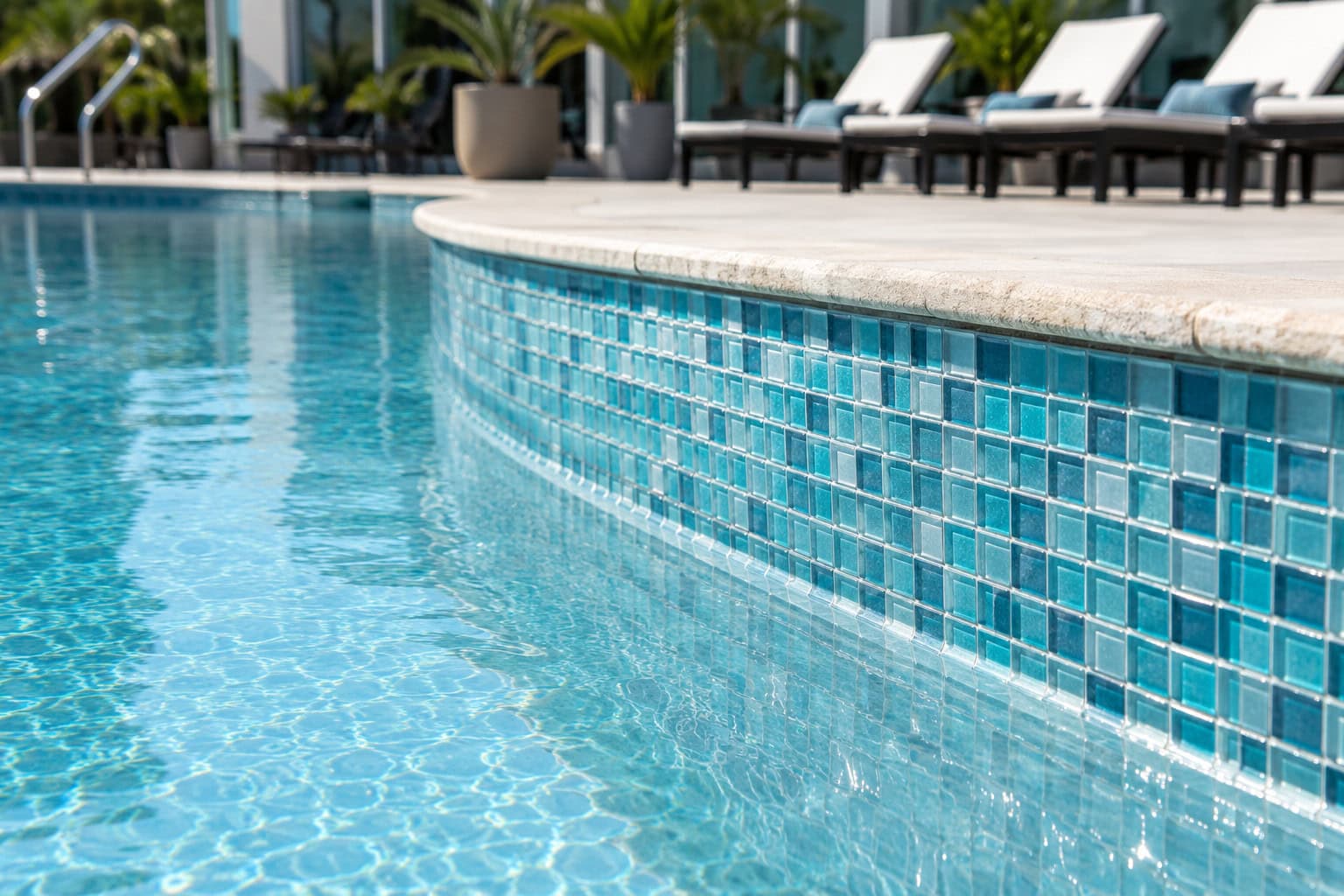
For manufacturers supplying materials for public swimming pools in Florida, an unexpected request for color or light-reflectance testing can raise some questions. What do these measurements have to do with pool safety? What do the numbers mean? Does the requirement apply to every type of pool finish? And if you’re manufacturing ceramic or glass tile rather than a traditional cementitious pool finish, does the requirement apply to your product in the same way?
The answer starts with Section 454.1.2.4 of the 2023 Florida Building Code, Building, which requires pool floors and walls to be white or light pastel in color and to reflect rather than absorb light. The section also establishes measurable criteria: a dry Lightness value (CIE L value) of 80.0 or greater and a wet Luminous Reflectance Value (CIE Y value) of 50.0 or greater.
But what do these requirements mean, and why were they added?
Why Does Florida Measure Pool Finish Lightness?
The underlying purpose of Florida’s pool color requirement is visibility.
A light, reflective pool interior helps improve visibility within the pool, including the ability to identify someone who may be in distress. Historically, the Florida Building Code required public pool floors and walls to be “white or light pastel in color” and to reflect rather than absorb light.
The intent was clear, but the language was subjective. How light is “light pastel”? And how can a manufacturer, designer, or building official objectively evaluate whether a particular finish meets that description?
In 2017, the Florida Building Code was updated to provide measurable criteria for evaluating pool finishes. The revised requirements introduced instrumental measurements of CIE L, representing the lightness of the dry finish, and CIE Y, representing luminous reflectance of the wet finish.
These measurements provide objective values that can be used to evaluate a pool finish against the criteria established in the Florida Building Code.
What Do CIE L and CIE Y Tell Us?
Although the two values are related to the appearance of a surface, they describe different characteristics.
CIE L describes lightness on a scale where 0 represents black and 100 represents white. Florida requires a dry CIE L value of at least 80 for the interior finish coating described by the code.
CIE Y represents luminous reflectance, or how much visible light is reflected by the surface under defined measurement conditions. Florida requires a wet CIE Y value of at least 50.
The rationale submitted with the original Florida code change explained that considering both measurements provides additional information about how a finish may appear in a submerged environment.
This distinction is particularly relevant to traditional cementitious pool finishes. These materials can appear darker when wet, so evaluating the finish in both dry and wet conditions provides more information than a dry measurement alone.
It is important to note, however, that a laboratory measurement of a wet specimen does not exactly reproduce the optical conditions of an installed pool viewed through water. The wet measurement is intended to provide additional information about the finish’s appearance under wet conditions, rather than perfectly replicate every condition found in an actual pool.
Why Does the Florida Code Reference Three ASTM Standards?
This is where the requirement becomes less straightforward.
Section 454.1.2.4 references ASTM D4086, ASTM E1477 and ASTM E1347. These standards address different aspects of color and reflectance measurement rather than forming a single test method written specifically for swimming pool finishes.
In general:
| Standard | General Purpose |
|---|---|
| ASTM E1347 | Instrumental measurement of color coordinates using tristimulus colorimetry |
| ASTM E1477 | Measurement of luminous reflectance using integrating-sphere methodology |
| ASTM D4086 | Visual evaluation of metamerism |
The important takeaway is that the Florida provision references “testing methodology from” these standards rather than identifying a single ASTM test method specifically developed for determining compliance of swimming pool finishes.
What About Ceramic and Glass Tile?
The opening language of Section 454.1.2.4 addresses pool floors and walls broadly, requiring them to be white or light pastel and reflective rather than light absorbing. However, the quantitative CIE requirements immediately follow language describing an interior finish coating consisting of a nonpigmented white cementitious binder together with a sand/aggregate component. The code then states that “the finish coating” must meet the CIE L and CIE Y thresholds.
The development history follows the same structure. Alternative language proposed by pool industry associations and manufacturers specifically described a cementitious binder and sand/aggregate finish before establishing the CIE L and CIE Y criteria.
This distinction is particularly important when the proposed pool surface is a different material, such as ceramic or glass tile.
For example, a glossy or translucent glass tile can behave differently during instrumental measurement than a porous cementitious pool finish. Surface gloss, texture, transparency, backing materials and specular reflection can all influence color and reflectance measurements.
This does not mean a particular tile product is or is not subject to a project requirement. It means the specific code language and the material being evaluated matter.
Manufacturers receiving a request to demonstrate compliance with Florida pool requirements should therefore first confirm which provision the project authority is applying to the product and what testing or documentation is being requested.
The applicable building official or other authority having jurisdiction is ultimately responsible for determining whether a particular material satisfies project and code requirements.
Testing Can Help Provide Objective Data
For those navigating Florida’s pool finish requirements, understanding what testing is needed, and what the resulting data means, can be just as important as the testing itself.
IPA Laboratories can perform instrumental color and reflectance testing and report objective data such as CIE L and CIE Y, along with other color measurements as applicable. Testing can be performed under controlled conditions, including dry and wet conditions when appropriate. These results provide manufacturers, designers, and other project stakeholders with objective data that can be compared with specified project criteria.
The resulting data can support a project’s evaluation of the material, while the design professional or authority having jurisdiction (AHJ) determines how the applicable Florida Building Code requirements apply to the specific product and project.
If you’re being asked to provide CIE L or CIE Y data for a pool finish or other material, IPA Laboratories can help you understand the testing needed and provide the objective measurements required for your project.
